Materials & Craft
Bag Material Evidence: Fibre, Weaving and Environmental Claims
Build a component record before choosing a bag. Material names, a woven appearance and environmental wording answer different questions. Use the checklists below to request composition, production-method and claim-specific evidence for the selected SKU; keep unsupported claims unverified.
Draft editorial check:
Content updated:
On this page
- Calculation and purchase decision
- Ask about components rather than one label
- Choose the sample checks that matter
- Carry the evidence into the purchase brief
- Paper-woven bags, paper-look finishes and Tyvek labels
- Handwoven bags: define the production step you need
- Sustainable bags: make the environmental claim specific
- Request component-level material evidence
- Sources and calculation method
- Questions before purchase
Calculation and purchase decision
A seller’s “leather bag” description is insufficient if the brief requires a leather body and synthetic lining. Build a four-zone record: body, trim, lining and reinforcement. An invoice description is a seller statement; a close-up shows appearance; composition needs an appropriate supporting document or agreed test. Do not upgrade one evidence type into another.
Ask about components rather than one label
Request separate answers for the outer body, coating or surface finish, backing, trim, handles and lining. A listing can describe one component while the rest of the bag uses different materials. Save the seller’s original wording and the exact SKU; do not silently turn a broad material label into a more specific claim.
Microfiber can refer to a fiber-based construction or backing, and a PU description may refer to a coating or a synthetic construction. Ask how the seller uses the term for this product. For a leather claim, ask which components the claim covers and request available supporting evidence. Avoid treating a photograph, price or smell as proof.
Swipe the table horizontally to see all columns.
| Question | Evidence to request | Decision if unresolved |
|---|---|---|
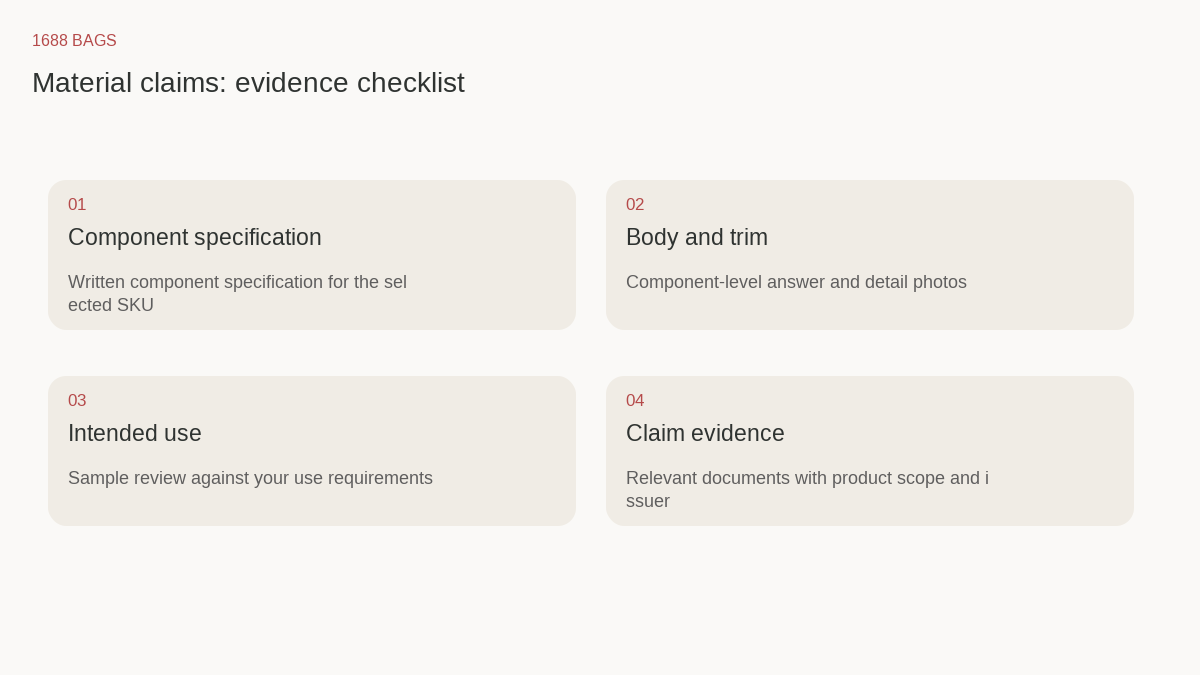
| What is the body and surface construction? | Written component specification for the selected SKU | Keep the claim unverified |
| Does trim differ from the body? | Component-level answer and detail photos | Do not label the whole bag from one component |
| Will it suit the intended use? | Sample review against your use requirements | Test before scaling the order |
| Are performance or environmental claims supported? | Relevant documents with product scope and issuer | Omit unsupported claims from resale copy |
Choose the sample checks that matter
Record practical requirements such as flexibility, finish consistency, color transfer concerns, closure function and edge quality. Agree which checks the desk can perform and whether specialist testing is needed. Basic visual QC can document visible differences; it cannot establish every chemical, durability or regulatory property.
If color matching matters, agree a physical reference and viewing method. Lighting and screens can alter apparent color. Keep sample observations distinct from batch-wide conclusions, and ask whether the reorder uses the same specification.
Carry the evidence into the purchase brief
Record each important claim as seller stated, sample observed, document received or independently tested, with the date and product scope. A document for another model or material should not be treated as evidence for the selected bag. Ask for clarification when evidence and listing wording disagree.
Paper-woven bags, paper-look finishes and Tyvek labels
For paper-woven bags, ask whether “paper” describes the weaving strip, a surface effect or another component. Record the body, coating, backing and lining separately. A listing name such as “Dupont paper” does not by itself identify a brand, prove paper fibre or verify the composition of the finished bag.
DuPont describes Tyvek as a synthetic HDPE material. Its stated recycling route for pure Tyvek depends on facilities accepting flexible HDPE. Those manufacturer facts do not establish that a marketplace bag is genuine Tyvek or that its mixed construction has the same properties.
Swipe the table horizontally to see all columns.
| Label to clarify | Request for the selected SKU | Decision while unresolved |
|---|---|---|
| Paper-woven | Material of the strips, coatings and lining, with component specification | Do not infer paper composition from texture |
| Paper-look or a branded material name | Exact material reference and evidence connecting it to the bag components | Keep the seller wording separate from verified identity |
| Straw or basket | Declared fibre and component breakdown; distinguish material from shape | Do not treat a basket silhouette as proof of straw fibre |
Handwoven bags: define the production step you need
“Handwoven bags” can be a requirement in a buying brief, but a photograph of a weave cannot establish the production method. Ask the seller which steps are done by hand: weaving the body, assembling panels, attaching handles or finishing edges. Record the answer as a seller statement until the evidence supports a stronger conclusion.
If manual weaving is essential, request a method description and relevant process records or a demonstration tied to the selected model. Agree how the evidence relates to the sample and proposed batch. A record of hand finishing does not establish that the body was handwoven. When the required step remains unverified, defer that requirement or compare the item simply as a woven-construction candidate.
Swipe the table horizontally to see all columns.
| Buying requirement | Useful evidence request | Limit of the conclusion |
|---|---|---|
| Manually woven body | Which component is woven, method description and model-linked process evidence | The visible pattern alone does not establish the method |
| Hand assembly or finishing | Identify the exact assembly or finishing step and document its scope | Do not describe the entire bag as handwoven from that step |
| Repeat order consistency | Confirm the selected variant, sample reference and proposed production method | A sample observation is not automatically a batch-wide finding |
Sustainable bags: make the environmental claim specific
The FTC’s U.S. Green Guides summary cautions against broad, unqualified environmental claims and explains that certification does not replace support for the claims made. Use that resource to frame evidence questions; check the requirements of the intended selling market separately.
If your brief calls for sustainable handbags, eco paper bags or sustainable paper bags, specify the environmental attribute you actually require. A material name, natural colour or supplier seal is not a comparison of the bag’s overall environmental impact. Record the claim, component, selected SKU, date and supporting record before deciding whether it is supported. This guide provides a verification method, not a catalogue of independently verified sustainable products.
Swipe the table horizontally to see all columns.
| Proposed claim | Record to request | If evidence does not match |
|---|---|---|
| Recycled content | Component, amount, measurement basis and records covering the selected material or product | Leave the amount unknown; do not invent a percentage |
| Recyclable | Scope of the bag or component, construction and acceptance by the relevant destination facility | Do not assume local acceptance or whole-bag recyclability |
| Environmental certification | Issuer, standard, validity, scope and the link to the selected SKU or material | A factory or different product’s record is not automatically evidence for this bag |
| Overall “sustainable” or “eco-friendly” | A specific intended benefit and evidence addressing that benefit and its scope | Do not convert one material attribute into an overall impact claim |
Selected seller / SKU / variant:
Body / coating / lining / trim:
Claim and component it covers:
Production-method evidence:
Document ID / issuer / date / product scope:
Destination handling or recycling conditions:
Unverified items / buyer decision:Request component-level material evidence
Edit this local table, then copy it into your sourcing request. Entries are not saved or sent automatically.
Example / reference — edit the fields below
Body / composition pending / close-up only / request supporting document

Sources and calculation method
Research reference date: . This is a source-reference date, not a publication date or a hands-on test.
Method: the editorial comparisons use the cited specifications; worked calculations state their assumed inputs. Product-page descriptions do not establish physical fit, material performance or stock.
- 1688 Bags — inspection service scope · · Service description; establishes scope, not an order result.
- DuPont — What is Tyvek? ·
- FTC — U.S. Green Guides summary ·
Questions before purchase
Can a photo prove that a bag is leather?
No. Use a component specification and appropriate supporting evidence; keep photo observations separate.
Does the material label tell me how long a bag will last?
No. Construction, finish, use and evidence from suitable checks all matter.
Can I repeat a seller’s environmental claim in my shop?
First verify its evidence and product scope; do not present an unsupported claim as established fact.